 A searchable, downloadable PDF of the original article appears below. Dan Williams is on the pastoral staff at University Chapel, Vancouver. Adapted from Starting (& Ending) a Small Group (LifeGuide® Bible Study) by Dan Williams. ©1996 by Dan Williams. Used by permission of InterVarsity Press, PO. Box 1400, Downers Grove, IL 60515.
I have started many groups. Each one seems to take longer to get off the ground. Either I am slowing down as the years pass or I learn something new with every group experience that should be dealt with up front. These insights become incorporated in the next start-up process, so it tends to take more time. Some people call this group initiation process “contracting,” other call it “covenanting.” The group agreement which results is vital to the health of a group.
With everyone in the group assembled, each member needs to be clear about the initial expectations and understandings that they and everyone else have brought into the room. So, once a quorum or minimum number of members has been achieved, call a meeting for the purposes of exploring your first session of group life together. Use this article as an agenda for the meeting. Just a reminder: Who should be digesting these small group principles and putting them into practice? The answer is: every one in the group. The best groups engage in a “gracious conspiracy” (to use the phrase learned from my colleague Paul Stevens at Regent College) between all members to make the life of the group work. So every member, and not just official leaders (or trainers), should be guided by what follows.
Conceiving (of) a Group
I like to ask people in small group workshops about when they believe a group actually has begun. Some say a group begins with the first meeting, others when the contract of group agreement has been finalized. These answers make some sense, but they miss a deeper truth: a group has already started to take shape with the first conversation between two people about that group. A pattern of group life has begun to be established, however loosely. Actually, the truth may lie even deeper: the first private thought about a new group has begun the birthing process, sometimes these “founding ideas” can be very persistent, especially if the idea-holders are persistent or persuasive. There are a lot of non-assertive people around at the start of a lot of groups, and it is often a service to the members when someone, like the leader, will bring forward a strong idea of where the group should go. There may be more democracy evident in future stages of the group, but at the beginning some direction will be appreciated. However, it is important to have that direction clearly articulated, and to let every member give a clear response to it. Another approach is for the leader to go to great lengths to have everyone share their group intentions, and then to build up a consensus statement.
The best thing you can do for a group you are joining is to work out your expectations ahead of time.
One of the worst things that can happen to a group is when people are not open about what they want out of a group. If you are not clear yourself, and if you do not communicate clearly, then how will anyone be able to know and help (even if that help means saying that they cannot meet your expectations)? Unclear or unspoken personal goals lead to an unfocused group, hidden agendas that can later be destructive, and general frustration in the membership. Elsewhere, I have described this pathology as group schizophrenia. One kind of leadership needed in the “founding” meeting is helping people unpack the group baggage they brought with them. The best thing you can do for a group you are joining is to work out your expectations ahead of time. These expectations come from a number of sources:
1. Past group experiences. Negative: things you never want to repeat. Positive: things you want to try again.
2. Current group experiences. If some aspects of small group life (e.g., Bible study) are already being covered elsewhere, you may not need it in a second group you are joining.
3. Future experiences desired, according to your life circumstances (e.g., you have young children, and would like to be in a parent survival group).
4. Idealized experience: following some picture of a group derived from the Bible, a book or a workshop. (Note that these pictures are not always accurate, e.g., the idea that Jesus would never have a group with closed membership.)
Such personal threads become woven together in a sense of purpose.
What to do
Identify a secretary for the proceedings. If someone volunteers, you have found another group servant. Written notes are important for checking signals later. If there is no obvious one to act as the facilitator of this process, then import someone.
Begin by having each member give a brief groups biography (a group-ogra- phy?). Here are some questions to use as an outline: of what types of groups have you been a part? How did they form? How was each group led? What leadership did you provide? What was most satisfying about your most recent group? What would you like to have changed? What focus would you like your new group to have?
There is no need to go too far at this time. As the plan normally will be to have a short run of meetings as a trial period for building relationships, any deeper analysis of personal goals can wait until the trial period is over and the group is setting sail for many months together.
Membership Dues
Even though the initial approach to group life will be short-term and circumscribed, starting with the right attitudes towards one another and the group is very important. Here are some basic commitments:
1. To listen carefully to one another, to God and to his word; to listen more than speak.
2. To be as honest as possible with one another, though not “gushing” or disclosing facts that are not normally shared in a roomful of relative strangers.
3. To keep confidences, not talking about one another outside the group.
There are four other areas that the group would need to discuss, unless the group leader is going to establish a norm unilaterally on this first round:
1. Should new members be permitted (encouraged?) during the first brief phase of the group’s life?
2. How strict should starting and ending times be?
3. How frequent will the meetings be, and how intense are the expectations for consistent attendance?
4. How will leadership and decision-making be handled?
Now, finally, the time for which you have all been waiting. Cookies. When will refreshments happen: early or late?
It is good to deal with these basic issues first. I have known groups that almost never got going because the members started with their day-timers. What day to meet, what time, when will we have the cookies: these matters can loom large in the mind of group members. However, if such details are attended to early in a contracting process, they can at best distract from more important questions and at worst discourage a group due to the difficulty of solving the logistical issues.
So, even before logistics, the next place to turn is the basic activities of the group: what actually happens inside and outside meetings. This is the phase where definitions are all-important. Bible study means different things to different people: digging into a passage inductively, meditating on a passage, applying a passage. Sometimes people are hoping to use a variety of methods. Similarly, prayer can be approached in different ways, and sharing is a notoriously slippery idea.
Now, finally, the time for which you have all been waiting. Cookies. When will refreshments happen: early or late? Usually there is no one right answer to these sort of logistical questions. Sometimes there doesn’t seem to be any answer at all. My favourite example is when we had three nurses on variable-rotation shift work to accommodate in one group. This illustrates the wisdom of leaving questions like scheduling to this point in contracting. After so many deliberations on purpose, basic issues and activities, you become committed to one another and excited about the group. So almost any practical problem can be worked out. What did we do with our nurses? Even in this overscheduled era, rather than having a set meeting night, we were able to decide at the end of each meeting what the next optimum meeting day would be, in order to maximize N, the variable denoting the number of nurses in attendance. A complicated formula, you say? Not if you are already sold on the value of the group beforehand. Besides, one of the nurses was my wife.
What to Do
Ask if any member has another key commitment to add to the agreement at this early stage of the group’s life. One clause in the agreement may be to note that the group will make future decisions (e.g., how to shape a second contract) by a more fully consensual approach, with less direction from the leader.
Here are some guidelines for some of the thorny issues that arise in contracting:
1. How often to meet. Every two weeks is an increasingly popular pattern, but weekly is still preferable.
2. How long to meet. Be realistic. Better to end the meeting wanting more rather than have members be relieved that it is finally over.
3. Location. Do not make a fetish out of moving the meeting around. If you have a good spot and the host doesn’t mind you using it regularly, then do so. It is one less thing you need to remember or organize. Of course, there are good reasons to shift location, such as when it allows equality in the burden of families having to get babysitters.
4. Speaking of kids. Unless your purpose actually mandates having children in the meeting (e.g., intergenerational nurture-community groups), or restricts membership to those without children (e.g., infertile couple support groups), you will most likely will have to deal with the issue of child care. In my experience, this issue is never solved perfectly, and every solution depends on the age and flexibility of the children involved. Here are three ideas: rotate the location of the meeting, using the family homes in sequence to minimize the number of times each family needs to secure a sitter; put children to sleep in another room in the host’s home, or all together with one sitter in a nearby home; help as a group to pay the sitting costs of a family on a tight budget. Sometimes a parent finds it difficult to accept this sort of gift, but it is better to gently insist rather than have that parent consistently miss meetings.
5. Refreshments. Surely this is noncontroversial. Not always. Some people bring a certain asceticism into groups, promoting the idea of not being distracted from spiritual matters by bread alone. However, I want to affirm a theology of eating, especially as a vehicle for community-building in a group. Now, on whether to eat first or last, there are pro’s and con’s for either choice. You can figure it out.
Everyone should be encouraged to identify in their own mind and heart how God could use them in the group according to their gifting and personality.
As a discipline, continue to put the results of the whole discussion down in writing.
Take Me To Your Leader
If the preceding section suggests how to start out as a responsible group member, then here is where we turn to another reality: everyone in a group is also supposed to be a responsible leader. It is true that many groups will have a designated coordinator or leader, either known from the start because they are the founder, recognized by the group at an early stage, or appointed by the small group program director. But there are many other leadership positions that augment the overall or coordinating leadership. Some typical group leader roles are:
Host: providing a comfortable meeting circle and organizing refreshments;
Study Leader: preparing studies and facilitating discussions;
Pastor: keeping in touch by phone, especially with absent members;
Prayer Leader: keeping a prayer journal listing requests and answers.
Worship Leader; acting as organizer and master of ceremonies for any music, singing or other worship activity; outreach project manager (usually not too ambitious at this early stage): reminding people about their personal witness;
Social Event Coordinator: just what it says!
What to Do
Not all of the above positions need to be filled right away, and not all by separate people (though the overall group leader should try not to have more than one other assignment). Everyone should be encouraged to identify in their own mind and heart how God could use them in the group according to their gifting and personality. Be prepared to hold any idea lightly, with each one serving the group as opportunities fit with resources, and waiting for others to confirm any settled position or gift. The attitude must be: volunteer, and be open to evaluation. Realize that some of the jobs needing to be done to make a group run smoothly are just pure service or administrative ones, e.g., phoning everyone to change a meeting place, baking. Everyone needs to ask: Am I willing to pitch in? Add any conclusions on assignments to the written group agreement.
The final clause in the group agreement should answer the question: when will we evaluate how the trial period has gone and plan the next step? Be specific about the date. There are good reasons for making it no more than a month or so away.
Now have everyone sign the contract. Signing in blood is optional.
Wrap-up: Daddy, Are We Almost There…?
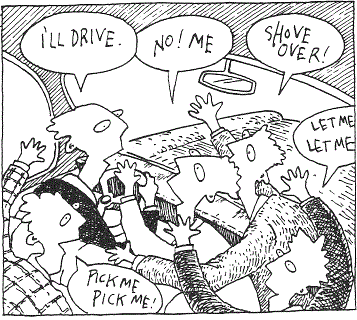
During a long car trip, children frequently interrogate the driver about the estimated time of arrival. This trip to the group launching pad may also have seemed long to some members, often taking two full meetings. But a slow, careful start is worth it. After all, you may be spending two or three years together.
Another advantage of taking your time is the opportunity to find out if someone should not be in the group. A classic case of the latter problem is where someone looking for a low-intensity social group gets into a high-commitment setting. They stay in the group, at least “on paper,” because they want a group and don’t want to appear antisocial (after all, sociability was their goal). However, they never seem to quite engage with the focus, that is, when they show up at all. This makes the group feel mildly frustrated, and the uncommitted one feel mildly guilty. No one wins. It is better for all concerned to have preliminary, exploratory meetings before the first official one. There will never be an easier time to leave the group. At the end of the process, ask people to be as honest as possible about their sense of belonging. Have alternative groups ready to suggest, or alert an appropriate church leader about anyone who has not in the end bought into the contact.
Dirk van Stralen