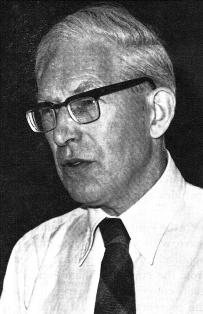
 A searchable, downloadable PDF of the original article appears below. Dr. Packer is Professor of Historical and Systematic Theology at Regent College, Vancouver, B.C. This article is an expansion of the third part of Dr. J.I. Packer’s first talk on “The Holy Spirit Opening the Scriptures” given at the 1986 Annual Meetings of the Renewal Fellowship Within The Presbyterian Church in Canada.
I am not sure that we who preach the Word always fully appreciate the significance of what we are doing, nor am I sure that we always plan and direct what we do as effectively as we might. Let me put the matter to you as I see it. (I speak here directly to my fellow-preachers, though the rest of you are free to listen in.)
Holy Scripture is itself God preaching. I use that phrase, God preaching, constantly these days to describe the Bible, for it holds together the two thoughts that, on the one hand, all Scripture comes from God and, on the other hand, it is all his Word spoken still, here and now, to his whole church and to each one of our hearts. What is said in Holy Scripture is not only what God said long ago when first he gave it; it is what he says right now to everyone who is confronted by it. Holy Scripture is the dynamic reality of God preaching, teaching, applying, talking directly to all those to whom the text comes, speaking to us about him and us individually. We should always think of the Bible in this way, as the living, searching, piercing, powerful Word of God.
And our business as preachers of the Word is to fulfil the role of being mouthpieces for God’s message, just as the biblical prophets were. We should see our ministry of the Word as prophecy; that is the biblical category to which it belongs. Without going into any of the other questions about prophecy that are agitated these days, let me lay it down that prophecy means precisely speaking the Word of God with application, as a message to the hearers. So, when the Scriptures are preached as they ought to be, prophecy is the proper name for what is going on. For when preachers handle the Bible properly they do not, so to speak, stand in front of it, between it and congregation, talking on the Bible’s behalf, but making themselves and their thoughts about this and that the focus. Instead, they stand, as it were, behind and under the Bible, deliberately making themselves the human agents and instruments and sounding-boards whereby the text itself may deliver its own message to those whom the preacher addresses. When texts talk through preachers, it is God himself preaching in and through what they say. This is at once the mystery and the glory of the preaching ministry.
I ask all of you; do you think about preaching this way? When you bow your head and pray before each worship service starts, do you ask the Lord that the reality of prophecy in this sense may be your experience before the service is over? And I ask my fellow-preachers: do you prepare your sermons with this sense of the significance of what you are doing? Do you see your task as that of becoming the mouthpiece for the message of God to your people in your text?
If we who preach are to fulfil our role, two things must happen in our preaching: the truth in the text must be allowed to declare itself, and its application to people’s lives must be allowed to come out also. Application is of the essence of exposition. Explaining a text without applying it is lecturing, not preaching. Historical exegesis is not enough. We must move from what the text meant as God’s message to those to whom it was first addressed to what it means as a message for men and women today. Biblical talk is not preaching unless it is prophecy, and it is not prophecy unless it includes application.
The great masters of application were the Puritans, and I should like to leave with you this thought about application, which I have adapted from the Puritan William Perkins. In every congregation you can guarantee the presence of at least six types of people; so as you plan your preaching you should make sure that you are regularly applying the word to the condition of each type.
What are they? First, there are the complacent churchfolk who are as yet spiritually unawakened. They think they are Christians because they are regularly at church. They have the form of godliness but have never entered into its power. They need applications of the Word that will, so to speak, put a bomb under their seat and stir them to seek the Lord.
Then there are serious seekers who know that in Christ and in Christianity the wisdom that they need to live their lives is found, and so are trying to learn the Christian way of looking at everything and facing up to everything. They come to church for help in focusing Christianity. They want to learn. What they need is instruction about all the issues of living with which the Bible deals, spelt out in fully contemporary terms.
Category three is people not far from the kingdom: people convinced of their own personal need of Christ and his salvation. They need constantly to be pointed to the Christ of Calvary and the Empty Tomb – the Christ who says to them: “Come to me, and I will give you rest.” The kind of application that they need is evangelistic, weaning them away from all forms of self-reliance in religion to rely wholly on the blood, power and love of Jesus Christ as Saviour and Lord.
Fourthly, there are young Christians, new converts and those who have recently entered into assurance. They need building up and forearming against the temptations by which Satan will now seek to derail them, and our applications must be angled to their requirements also.
In addition there are mature Christians: middle-aged and elderly people who have walked with the Lord for many years. Now they are exposed to the characteristic temptations of physical decline and old age – temptations, that is, to slack off, to settle on their lees, to allow their hearts to cool as physical vitality diminishes. They need constant applications of the Word for their encouragement and the maintaining of their zeal and joy.
Finally, in every congregation there are always Christians in trouble – tempted, fallen perhaps, shocked and ashamed at themselves, traumatized by things that have happened to them or to those near and dear to them, fearing for their sanity in some cases, carrying within them aching anxieties that are often too painful for them to verbalize or to share. It has been well said that in every congregation you can count on there being at least one broken heart. The Word must regularly be applied to such in a healing and supportive way, with proper tenderness, remembering that the sense of need that folk in trouble feel is the most poignant and anguished of all.
You cannot, of course, in half an hour, or whatever length of time you can claim for the sermon, apply the Word with equal adequacy to all six human ypes. But what you can do is plan your preaching week by week with reference to this applicatory grid so as to ensure that all the different sorts of application regularly get made. You are to be like a wise cook, whose business it is to serve meals that benefit everyone. You know what will gratify the tastes and fit the dietary needs of different members of the family, and in planning the meals you should make sure that there is something to nourish everybody in what you serve up. Most of the complaints that we hear (and utter!) about the lopsidedness of particular pulpit ministries are really complaints about lack of range and systematic coverage in application. There is much discussion today on how preaching can be upgraded; for most of us, increased emphasis on, and skill in, application is the major part of the upgrading that our hearers need.
Let me give you this thought also, another bit of Puritan wisdom. There are three basic sorts of application of God’s truth: to the mind, to the will, and to the conscience. All three types of application need to be made to each of our six types of hearers.
Application to the mind is for clearing heads and getting thoughts straight. Its logical form is: “Now, if this is true, you see that we ought to be acknowledging and affirming these conclusions that follow from it, and denying these (familiar, popular) opinions which are contradicted by it.” Application to the will has the logical form: “Now, if this is true, you see what we ought to be doing, even if the world around would never dream of behaving so, and you see too what we ought to stop doing, and never do, even if the world around is doing it all the time – so let us go to it, starting now!” And application to the conscience, which is for self-assessment, has a logical form like this: “Now, if this is true, you must ask yourself questions: have I accepted this? am I obeying this? am I a faithful or an unfaithful child of God in this matter? am I, indeed, in the faith at all? in what ways does this truth show me that I need to be forgiven and changed?” – and so on. In our preaching of the Word, as in our own study of it and meditation on it, all three types of application should be present constantly.
Such applicatory preaching as I have described is a rare thing today, but we need it. To my fellow-preachers I say: probably you, like me too often, have been so concerned to preach sermons that pass on what we call “content” – Bible knowledge, knowledge of God’s truth – that you have failed to do enough application, failed, that is, to speak in a sufficiently searching and convicting way about the impact that scriptural truths should make on the lives of the different sorts of hearers. I try to get the content-application balance right in my own preaching and know that I often fail. But sometimes I wonder if my fellow-preachers even try.
Let us be clear then: our business as preachers is supremely to bring the Word home to the heart in all these different angles and modes of application – to “rip up the conscience,” as the Puritans used to put it, both for correction and for comfort. If we are not practising what Alexander Whyte called the “home-coming” application, our ministry of the Word is not half what it should be, and will not do half the good it might. So I say to myself, with you: preacher, mind your own business! Teach at all times – you must do that – and with your teaching reprove, rebuke, exhort – in other words, apply! I believe that if we preach this way we will find that congregations are grateful. Some are bound to complain because we are getting down to business, puncturing their pride, making them uncomfortable as long as they refuse to be changed and to move forward with God. But all who seek the Lord and truly care about God and his glory will testify that you are bringing the Word home to their hearts in a way that helps, and they will be thankful.
Explaining a text without applying it is lecturing, not preaching.
Who is the real preacher? The man who not only announces the divine message but also applies it; he is the real preacher. (“He” of course includes “she,” if your theology warrants that.) As I look and long for renewal in the churches, I find myself driven to pray that God will powerfully renew applicatory preaching among us – in other words, that he will increasingly make us into real preachers. The firstfruits of renewal in faith and fellowship worship and witness, have begun to appear already, but the fulness of renewal in mature godliness depends on a renewal of real preaching: not necessarily headline-hitting, but both heart-searching and heart-warming in its applicatory thrust. We cannot all be brilliant preachers, but by God’s grace we can all be real preachers, and to become such should be our number one concern.
Models (not for slavish imitation, but to give us the idea and set us going) can be found in the printed sermons of the Puritans, Jonathan Edwards, and Martyn Lloyd-Jones (see the Banner of Truth catalogue); also of C.H. Spurgeon, Alexander Whyte, A.W. Tozer, and many more. Moreover, as Jesus said, the Father will certainly bestow the Holy Spirit, to give insight and unction for the task, on those who ask him.
Preacher – or had I better now say, would-be preacher – what are you waiting for?